In 1931, Herbert William Heinrich proposed that for every major injury in the workplace, there are 29 minor injuries and 300 near misses (incidents that could have caused harm but did not). Whilst the precise ratios have been debated by researchers, the underlying principle remains widely accepted: near misses are early warnings of systemic failures that, if left unaddressed, will eventually result in serious harm.
What Is a Near Miss?
A near miss is an unplanned event that did not result in injury, illness, or damage, but had the potential to do so. Examples include a worker slipping on a wet floor without falling, a load shifting during lifting without striking anyone, or a chemical spill that was contained before anyone was exposed. Near misses are sometimes called 'close calls' or 'dangerous occurrences'.
RIDDOR reminder: Certain dangerous occurrences (near misses of a particularly serious nature) must be reported to the HSE under the Reporting of Injuries, Diseases and Dangerous Occurrences Regulations 2013 (RIDDOR), even if no one was injured. Schedule 2 of RIDDOR lists the specific categories of reportable dangerous occurrence.
Why Near Misses Are Under-Reported
Research consistently shows that near misses are significantly under-reported in most organisations. Common reasons include a culture in which workers fear blame or disciplinary action, a belief that 'nothing happened so there is nothing to report', a lack of clear reporting procedures, and management that does not visibly act on reports. Addressing these barriers requires a genuine commitment to a just and fair culture in which reporting is encouraged and rewarded.
Conducting an Effective Investigation
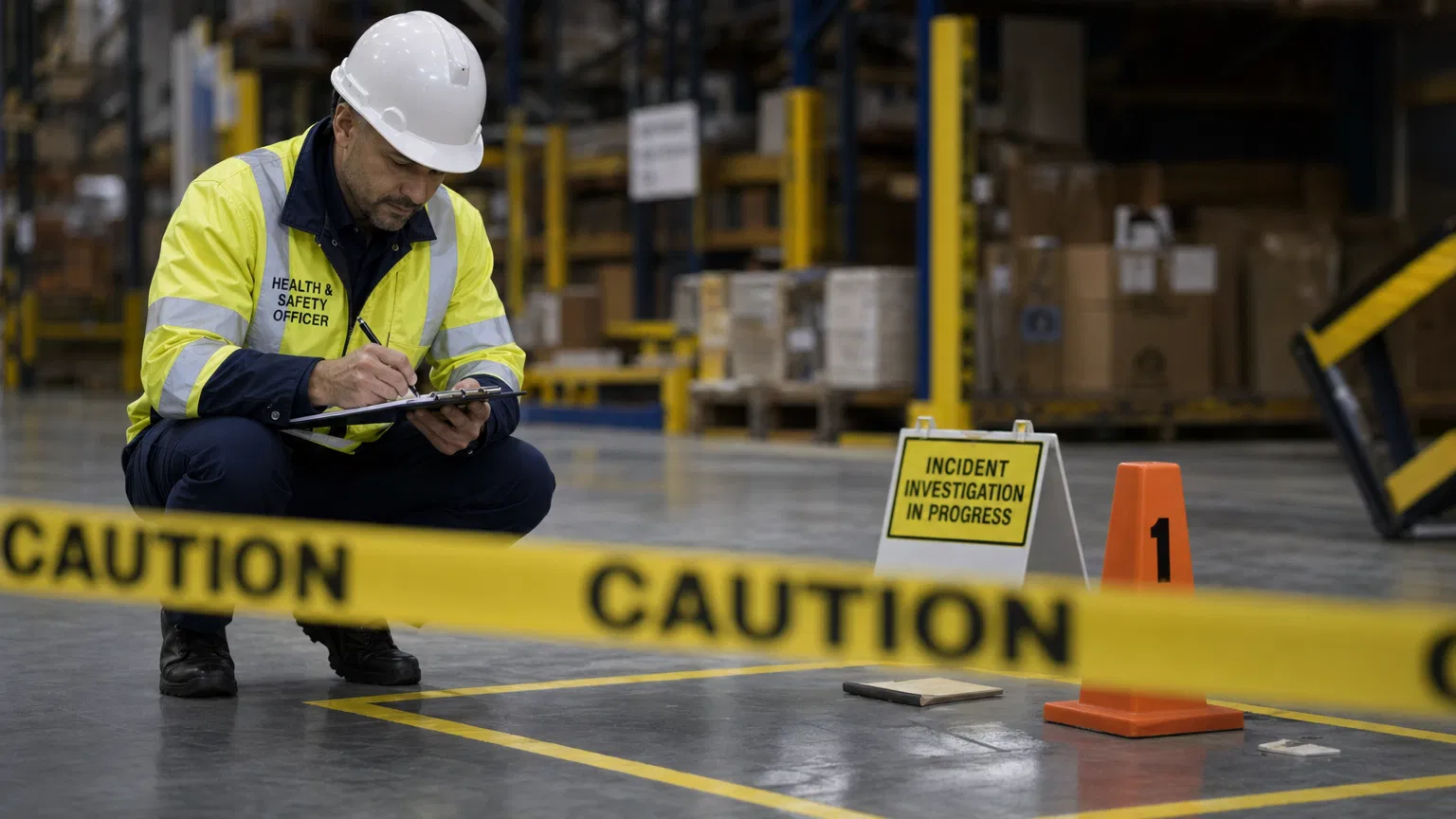
An effective incident investigation — whether of an accident or a near miss — aims to identify the root causes of the event, not simply the immediate cause. The immediate cause is what directly caused the event (for example, a wet floor). The underlying causes are the management system failures that allowed the hazard to exist (for example, no procedure for placing wet floor signs). Root cause analysis techniques such as the '5 Whys' or fault tree analysis help investigators dig beneath the surface.
- Secure the scene and preserve evidence as soon as possible after the event
- Gather witness statements promptly, while memories are fresh
- Review relevant documentation (risk assessments, training records, maintenance logs)
- Identify both immediate and underlying causes
- Develop and implement corrective actions with clear ownership and timescales
- Share learning across the organisation to prevent recurrence
- Review the effectiveness of corrective actions after implementation
RIDDOR Reporting Obligations
Under RIDDOR 2013, employers must report certain work-related injuries, occupational diseases, and dangerous occurrences to the HSE. Reportable injuries include deaths, specified injuries (such as fractures, amputations, and loss of sight), and injuries resulting in an employee being unable to work for more than seven consecutive days. Reports must be submitted online via the HSE website within the prescribed timeframes.
How Cinis Group Can Help
Our consultants provide independent accident and incident investigation services, bringing an objective perspective that can be invaluable when internal investigations may be perceived as biased. We produce clear investigation reports with evidence-based recommendations and can support you in implementing corrective actions and managing enforcement authority interactions. Contact us to discuss your requirements.
Editorial notice: This article is provided for general informational purposes only and does not constitute professional legal, regulatory, or health and safety advice. Whilst every effort has been made to ensure accuracy at the time of publication, laws and enforcement guidance change frequently — always verify information against current official sources such as hse.gov.uk. Any third-party names, organisations, or trademarks referenced in this article (including but not limited to the Health and Safety Executive (HSE), Network Rail, AB Agri, NEBOSH, IOSH, and IFSM) are the property of their respective owners and are referenced solely for informational purposes. Such references do not imply any affiliation with, sponsorship by, or endorsement from those organisations. © 2026 Cinis Group Ltd. All rights reserved. Reproduction of this article without prior written consent is prohibited.